Garment towns of the Pearl River Delta, read from the Huizhou end
Five places within 130 km of the RizzitGO warehouse, each tied to a public source. An independent guide, not run by RizzitGO.
A ring drawn tight around Huizhou
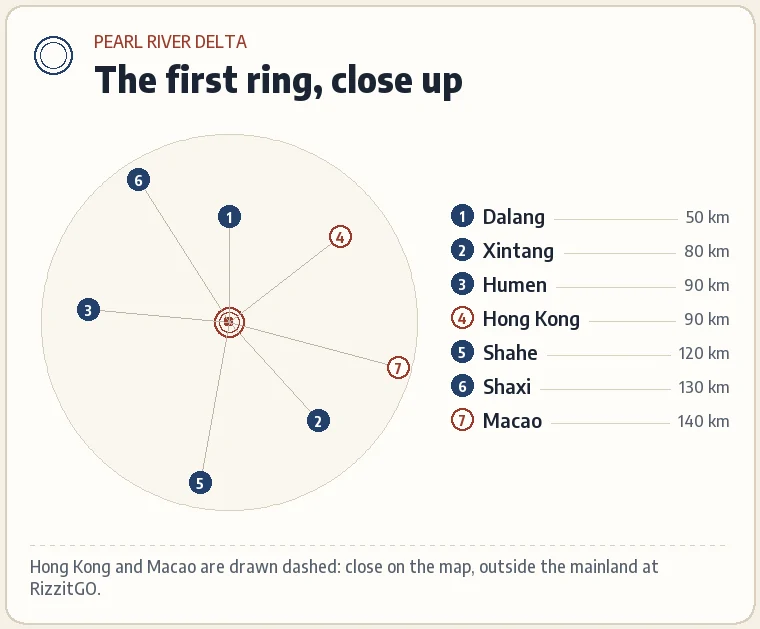
The Pearl River Delta wraps round the mouth of the river between Guangzhou, Dongguan, Shenzhen, Zhongshan, Hong Kong and Macao. Huizhou sits on its north-eastern edge, which puts five of the thirteen places we checked inside the first ring: none of them more than 130 km from the RizzitGO warehouse in a straight line.
For a buyer that has two practical effects. These towns are geographically close to Huizhou, but distance does not establish a next-day service or the seller’s dispatch date. And because these towns supply a great deal of clothing, the delta turns up often as the ship-from place, usually written as the city rather than the town: Guangzhou, Dongguan or Zhongshan.
Hong Kong and Macao also sit inside this ring on the map. They count differently at RizzitGO, which the last section on this page explains.
Xintang and the denim shelf
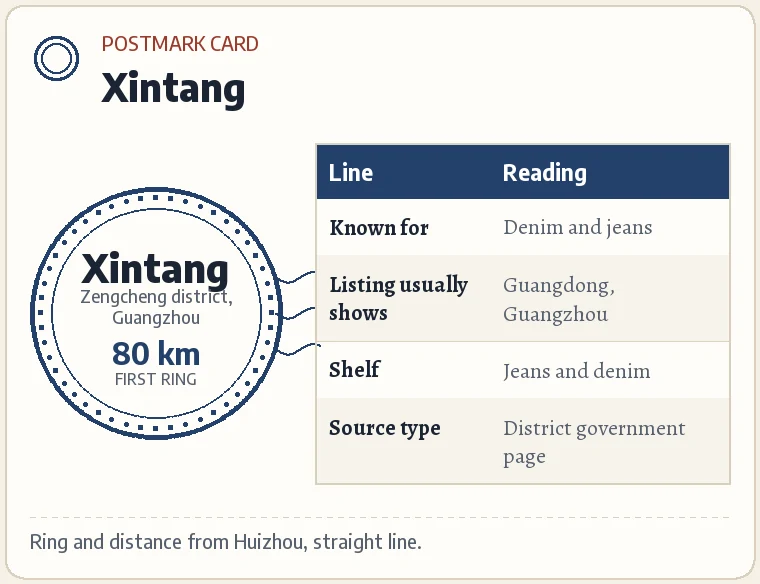
Xintang is a town in Zengcheng district, on the north bank of the lower Dongjiang, the East River, at the eastern edge of Guangzhou. It is widely known for denim. The district government's own pages call it the leading denim town in China, list national titles for its denim garment cluster, and trace the trade back to the early 1980s, with spinning, weaving, sewing and printing all done inside the town (district government pages, checked 17 October 2026).
On a listing, Xintang rarely appears by name. The ship-from line usually shows the city above it, Guangzhou, because Zengcheng is one of Guangzhou's districts. So a pair of jeans that says Guangzhou may come from Xintang, from a seller in the city centre, or from a warehouse anywhere in between.
Xintang is about 80 km from Huizhou, inside the first ring. Our jeans and denim shelf is the one we tie to it.
Humen, a garment town with its own fashion fairs
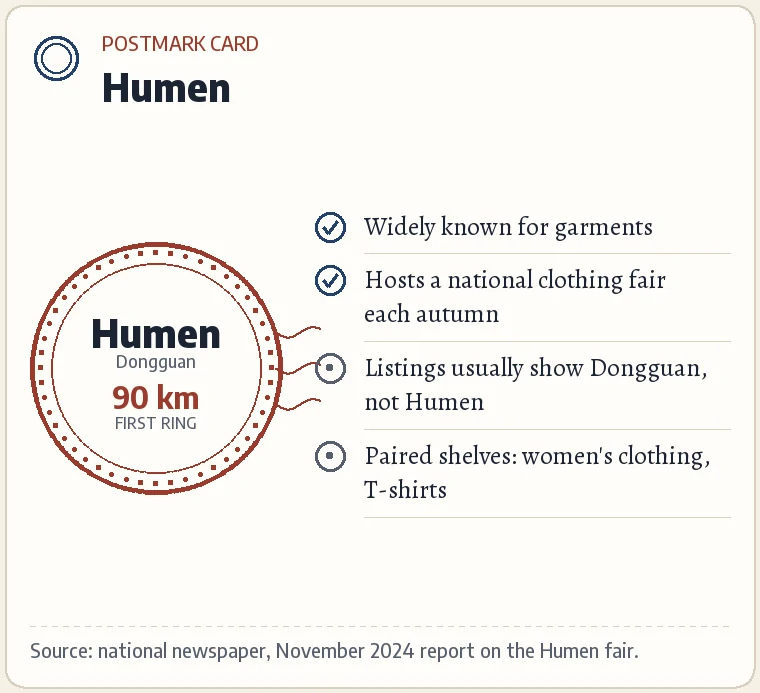
Humen is a town in Dongguan, on the eastern shore of the Pearl River estuary. It is widely known for garments, and for the national clothing fair and fashion week held there each autumn. A national newspaper reported in November 2024 that Humen's fashion trade was the first regional name in Chinese clothing to pass a value of 100 billion yuan, and that the fair drew visitors from twenty countries and regions.
The listing will usually say Dongguan. Dongguan is a big manufacturing city with several clothing towns, Dalang among them, so the city name alone does not pin a listing to Humen. Shop pages sometimes name the market or district in the shop description, which is worth a look if you want to know more.
Humen is about 90 km from Huizhou. We pair it with the women's clothing search, which in the catalogue is a keyword search, not one fixed category, and with the T-shirts shelf.
Dalang and the knitwear it is known for
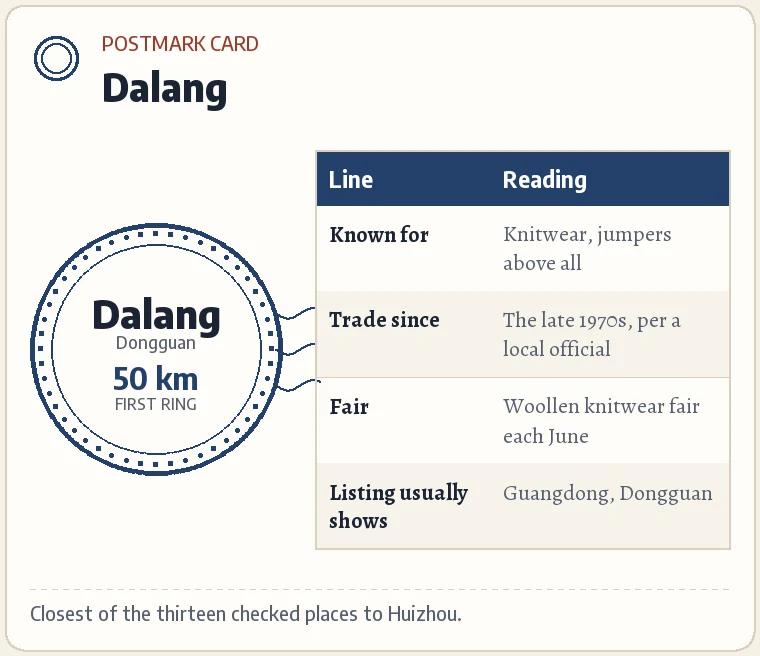
Dalang is another Dongguan town, about 50 km from Huizhou and the closest of the thirteen places we checked. It is widely known for knitwear, jumpers above all. A national newspaper wrote in August 2026 that the town turns out roughly one in every five jumpers made in the world, and a local official dated the trade to the late 1970s. Dalang also runs its own woollen knitwear fair each June.
Dongguan is a large manufacturing city, so the city name alone never proves the town. Still, when the ship-from line on a jumper says Dongguan, Dalang is the first town that comes to mind, though not the only one.
Our jumpers and knitwear shelf links Dalang with Puyuan in Zhejiang, roughly a thousand kilometres apart. Both towns are about knitwear; only the distance differs.
Shaxi and casual wear
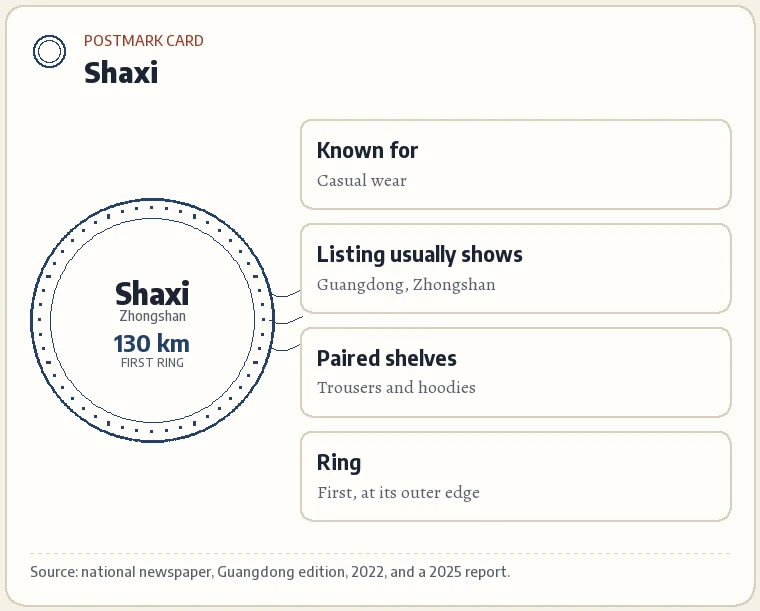
Shaxi is a town in Zhongshan, west of the Pearl River and about 130 km from Huizhou, the farthest of the five delta places but still well inside the first ring. A national newspaper's Guangdong edition names casual wear as Shaxi's local trade, alongside other Zhongshan towns known for their own goods, and a 2025 report describes the town as home to a dense cluster of clothing workshops and suppliers.
Casual wear covers a lot of the catalogue: trousers, hoodies, shirts, jackets. The listing will usually say Zhongshan. We pair Shaxi with the trousers and hoodies shelves.
One practical note from reading these listings: delta sellers of casual basics often sell the same cut in many colours, and stock can differ between colours. The postmark will not tell you that; the variant list on the listing will.
Shahe, the wholesale circle in Guangzhou
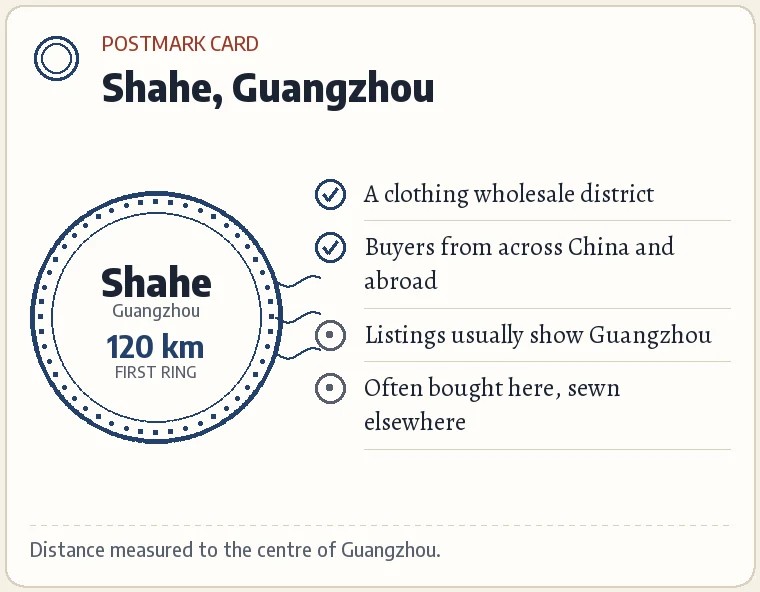
Shahe is a district of clothing wholesale buildings in Guangzhou's Tianhe area. Guangzhou city media describe it as the city's largest wholesale clothing circle, drawing buyers from across China and from Africa and the Middle East, and Hong Kong's statutory trade council lists Shahe with Baima and Shisanhang as the city's three main garment wholesale markets.
Wholesale markets matter for reading postmarks. A seller who buys at Shahe and resells online will usually post from Guangzhou, even if the garment was sewn in another town. So a Guangzhou postmark on a hoodie or a dress often means "bought and sent from the market city", not "made here".
The centre of Guangzhou is about 120 km from Huizhou. We pair Shahe with the hoodies and women's clothing shelves.
Two neighbours that sit across a boundary
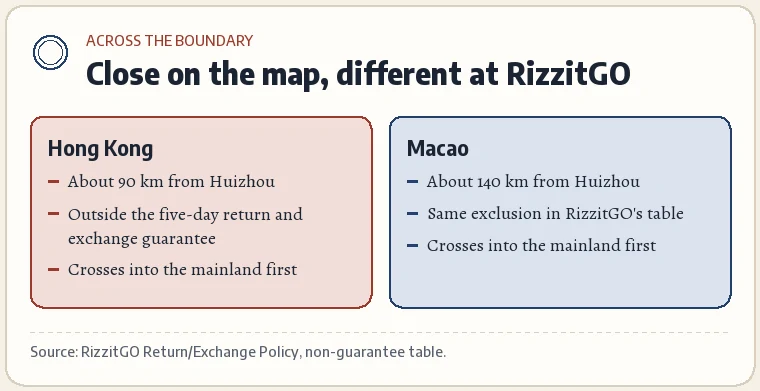
Hong Kong is about 90 km from Huizhou and Macao about 140 km, both inside the first ring on a map. Their geographical proximity does not make them mainland domestic shipments under RizzitGO’s return wording. Its return and exchange table names products bought from overseas, Hong Kong and Macao as items its five-day return and exchange guarantee does not cover, and a parcel from either place has to cross into the mainland before it reaches the warehouse.
So when a listing on a mainland platform shows a Hong Kong or Macao ship-from line, read it as an exception rather than a short hop. What changes for Hong Kong, Macao and overseas listings.