Garment towns of Zhejiang and Jiangsu, and a cashmere county in Hebei, for RizzitGO buyers
Eight places between 890 and 1,550 km from the RizzitGO warehouse, each tied to a public source. An independent guide, not run by RizzitGO.
Up the coast, in the Yangtze delta
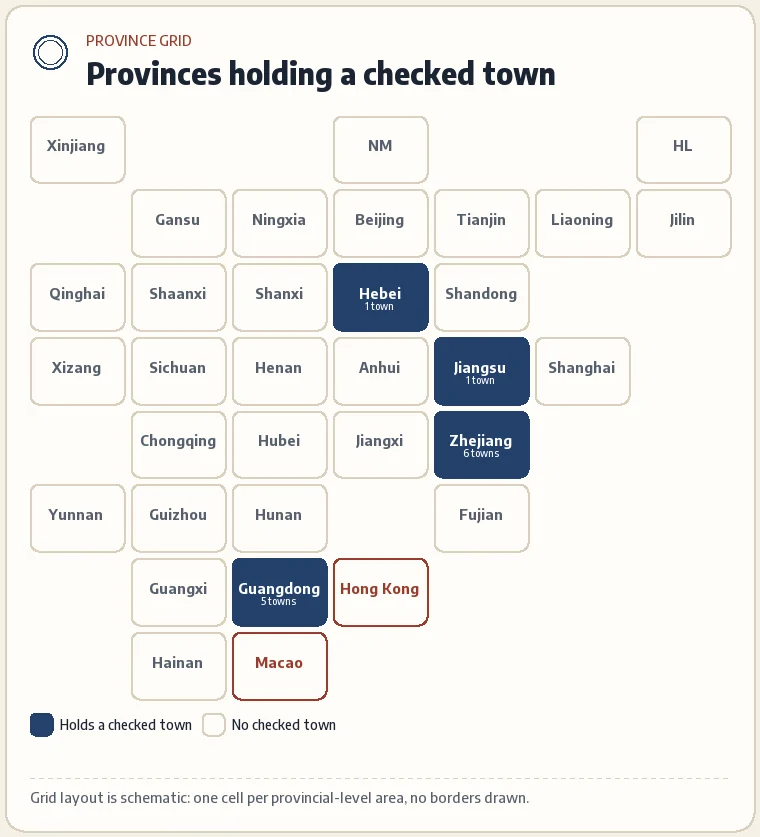
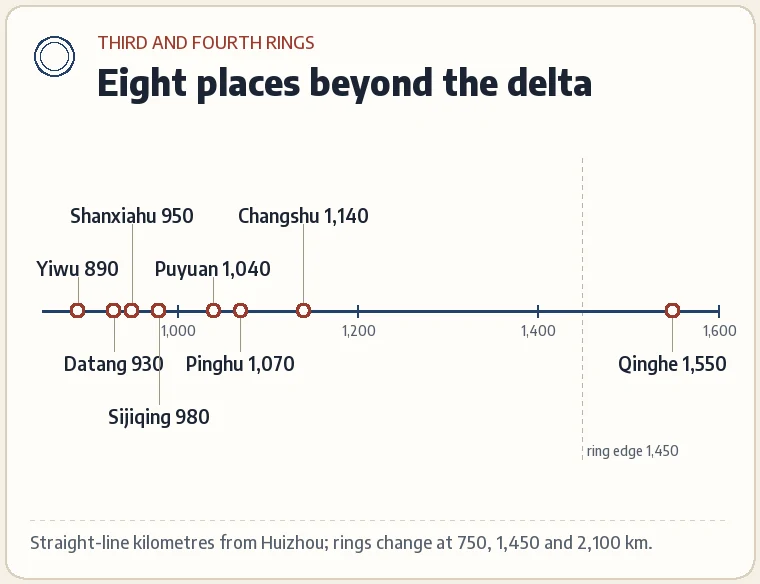
Eight of the thirteen places sit far from Huizhou. Six are in Zhejiang, the province south of Shanghai: Puyuan, Pinghu, Datang, Shanxiahu, Yiwu and the Sijiqing market in Hangzhou. One, Changshu, is in Jiangsu, north-west of Shanghai. The last, Qinghe, is in Hebei, on the North China Plain.
The Zhejiang and Jiangsu places fall between about 890 and 1,140 km from Huizhou, all in the third ring. Qinghe, at about 1,550 km, sits in the fourth. RizzitGO's forwarding rules call the domestic trip generally three to five days; it does not publish a separate arrival range for these distance bands. Ask for the seller’s dispatch date and track the actual courier.
These towns are known for some of the busiest shelves in the catalogue: jumpers, puffer jackets, socks, pearls and scarves. A postmark from Zhejiang on any of those is common, not a warning sign.
Puyuan and woollen jumpers
Puyuan is a town in Tongxiang, a county-level city under Jiaxing in northern Zhejiang. It was famous for silk centuries ago, and a national newspaper described it in 2024 as a place renowned for its woollen jumpers. The knitwear market there started in 1988 and grew into a national distribution base within about ten years, according to a 2023 report.
Because Puyuan is a market as much as a making town, sellers from all over the region buy and post from there. The listing may show Jiaxing or Tongxiang. A Tongxiang postmark on a jumper is about as common as postmarks get on that shelf.
Puyuan is about 1,040 km from Huizhou, in the third ring. It shares the jumpers and knitwear shelf with Dalang and, for cashmere, with Qinghe.
Datang and the sock shelf
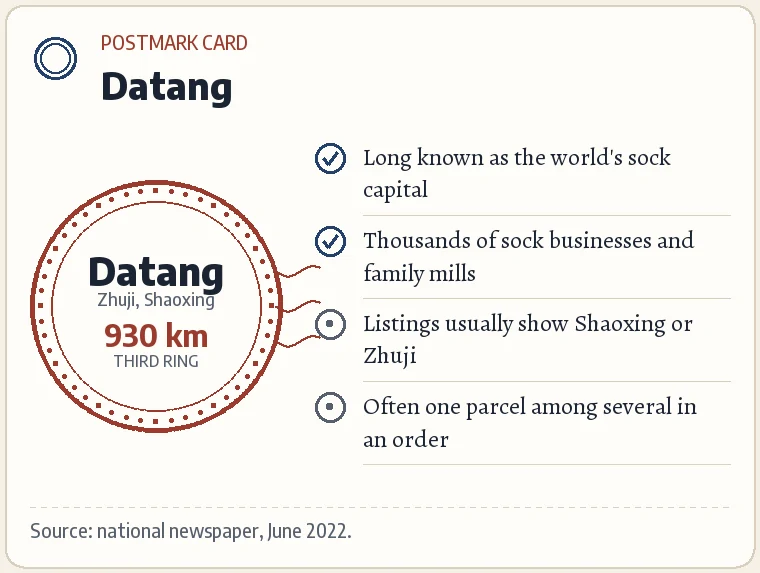
Datang is a subdistrict of Zhuji, a county-level city under Shaoxing in central Zhejiang. It has long been known as the sock capital of the world; a national newspaper repeated the title in 2022 and described thousands of sock businesses and family mills in and around the town.
Sock listings tend to come in packs and colour sets, and the postmark often reads Shaoxing or Zhuji rather than Datang. Socks are light and small, so they often ride along in an order that also holds heavier pieces from other towns; then the sock parcel from Zhejiang and, say, a hoodie from the delta travel to Huizhou separately and meet there.
Datang is about 930 km from Huizhou. The socks shelf is the one we tie to it.
Shanxiahu and freshwater pearls
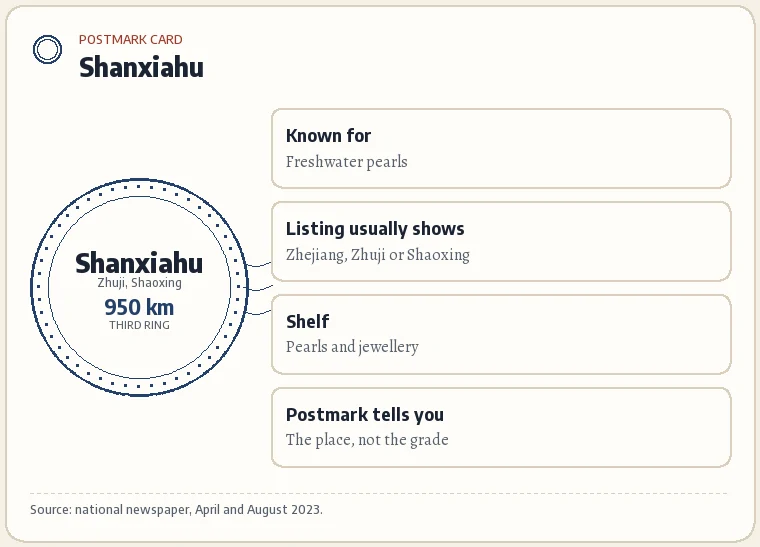
Shanxiahu is a township in the same city as Datang, Zhuji. It is widely known for freshwater pearls: a national newspaper piece in 2023 called it the pearl capital of China and the country's largest centre for processing and trading freshwater pearls, with a large livestream trade run from the township's villages.
Pearl listings are a good example of a shelf where the postmark and the product line up closely. When a strand or a pair of studs says Zhuji or Shaoxing, Shanxiahu is relevant regional context, but that city label does not establish the seller’s specific town or the item’s origin. What the postmark cannot tell you is the grade, the size or how the photos were lit; those you judge from the listing and from questions to the seller.
Shanxiahu is about 950 km from Huizhou. We tie it to the pearls and jewellery shelf.
Yiwu, a market of small goods
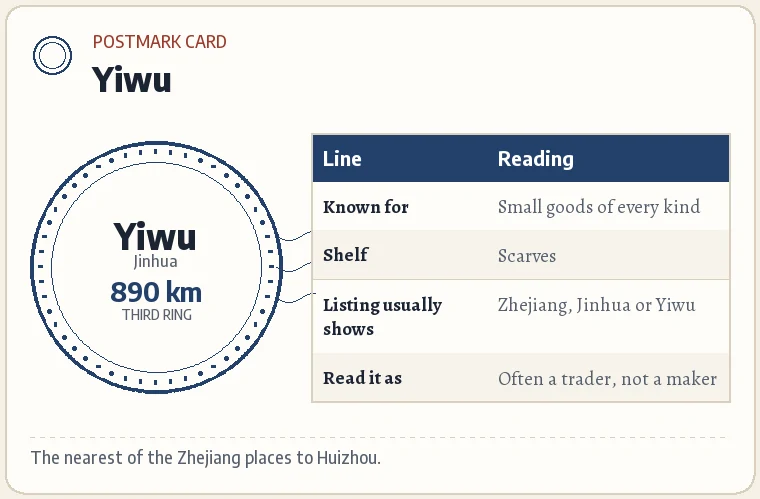
Yiwu, a county-level city under Jinhua in central Zhejiang, runs a wholesale market for small goods that national newspapers describe as the biggest of its kind. Scarves are among the goods made and sold there; a 2026 national newspaper report listed them with key rings, T-shirts and jackets among items made in the city.
Yiwu postmarks turn up on all sorts of small items, and on scarves in particular. The listing may say Jinhua or Yiwu. Because Yiwu is above all a trading market, a Yiwu postmark can just as well belong to a trader posting goods made somewhere else.
Yiwu is about 890 km from Huizhou. It shares the scarves shelf with Qinghe, whose cashmere goes into many knitted scarves.
Hangzhou's Sijiqing clothing market
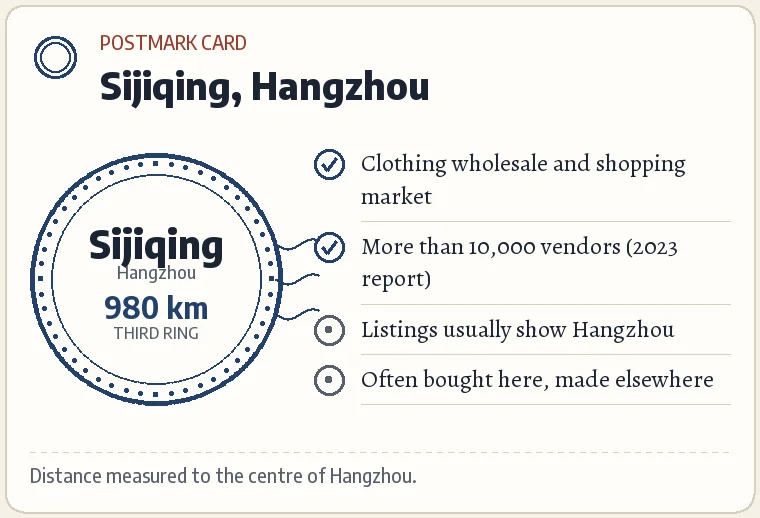
Sijiqing is a clothing market area in Hangzhou, Zhejiang's capital. A national newspaper described it in 2023 as one of China's largest wholesale and shopping markets for clothing, with more than 10,000 vendors, and noted that visiting athletes went bargain hunting there during the Asian Games in the city.
It plays the same role in Zhejiang that Shahe plays in Guangzhou: a place where sellers buy stock to resell. A Hangzhou postmark on a dress or a coat can mean the seller works from the market or from a warehouse near it.
Hangzhou is about 980 km from Huizhou. We pair Sijiqing with the women's clothing search.
Changshu and its garment wholesale town
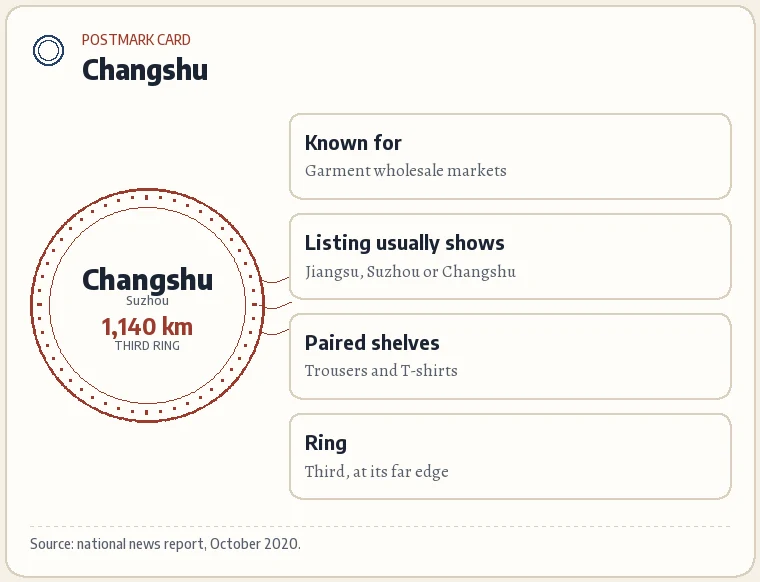
Changshu is a county-level city under Suzhou, in southern Jiangsu. Its garment wholesale area, described by national media in 2020 as about the size of 500 football pitches, holds 35 wholesale clothing markets and some 30,000 clothing shops, and its management committee had trained thousands of shop owners to sell by livestream.
A Changshu postmark can belong to a seller who runs a stall in one of those markets and a livestream on the side. The listing may say Suzhou or Changshu. At about 1,140 km, Changshu is the farthest of the third-ring places from Huizhou.
We pair it with the trousers and T-shirts shelves, two of the everyday garments those markets carry in volume.
Qinghe, far to the north, and cashmere
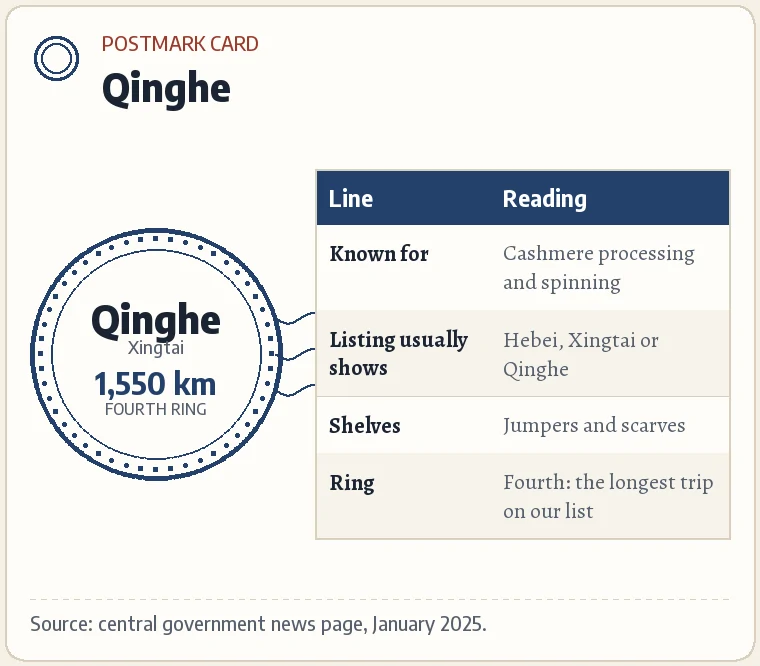
Qinghe is a county under Xingtai in southern Hebei, on the North China Plain near the Shandong border. A central government news page described it in January 2025 as a renowned cashmere raw-material processing and distribution centre, a cashmere spinning base and an important production and marketing base for cashmere goods in China.
Qinghe is the only checked town in the fourth ring, about 1,550 km from Huizhou. A cashmere jumper or scarf posted from Xingtai or Qinghe has the longest domestic trip of anything on our list; its distance alone does not determine whether it will meet the general domestic range. The January 2025 government-hosted report describes processing, distribution and spinning. A Qinghe dispatch address therefore does not identify the origin of the raw fibre or verify a particular garment’s composition.
We tie Qinghe to two shelves: jumpers and knitwear and scarves.
Pinghu and the puffer shelf
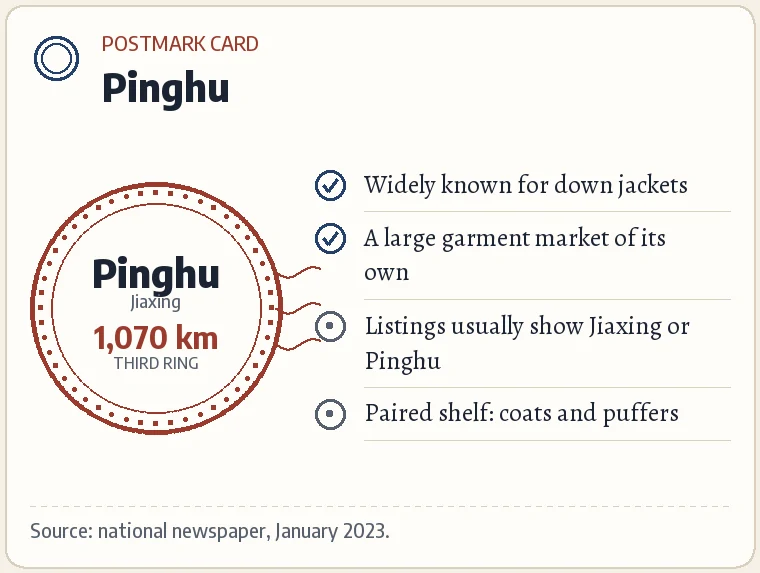
Pinghu is a county-level city under Jiaxing, on the coast of northern Zhejiang between Shanghai and Hangzhou Bay. A national newspaper described Jiaxing in January 2023 as a city known for its clothing trades, with wool jumpers in Tongxiang and down jackets in Pinghu, and reported that Pinghu, a city of under 700,000 people, ships more than 150 million down jackets a year from its garment market.
Puffer listings from here may show Jiaxing or Pinghu. Down jackets are bulky rather than heavy, and sellers usually pack them compressed in large bags. The postmark tells you the place; the fill and the weight are things to read on the listing itself.
Pinghu is about 1,070 km from Huizhou, in the third ring. It is the town we tie to the coats and puffers shelf.
Provinces with no checked town
Most provinces have no town on our list. That is not a judgement on them; it only means we could not tie a catalogue shelf to a town there with a public source we were happy to stand behind. Listings from Fujian, Jiangxi, Hunan, Shandong, Sichuan and elsewhere appear in the catalogue all the time.
For those, the reader on the home page measures to the provincial capital and gives the ring. A seller in a smaller city of the same province can be a good deal nearer or farther, so treat the capital as a rough marker. The rings, province by province.